AA – Always Accessible or Always Afloat - Term in Charter-Party which stipulates that the charterer must not order the ship to a port or berth where she would touch the bottom or perhaps be unavailable at any time due to tidal variations.
AAAA – Always accessible always afloat.
A/C – Account - This term is used when referring to a bank account and when allocating costs, such as in the phrase "for the a/c of charterers".
ABS – American Bureau of Shipping.
ABT – About - A conditional term used in qualifying cargo, time, bunkers or speed: when discussing cargo. "about" usually covers a margin of 5% either way.
Accomplished Bill of Lading – Original Bill of Lading which has been surrendered to the carrying ship at the discharge port in exchange for the goods.
A/E or ACC/EXC – Accept/Except - Term used by either the shipowner's broker or the prospective charterer's broker during the negotiations for the charter of a ship to signify that an offer or counter-offer is accepted apart from certain clauses or details.
AD VAL FRT – Ad Valorem Freight - Freight calculated on the value of the goods, expressed as a percentage thereof.
Addcom – Address Commission - Commission payable by the shipowner to the charterer.
Additional Demurrage – Amount of money paid to the shipowner by the voyage charterer, shipper or receiver, as the case may be, for failing to complete loading or discharging before the agreed period of free time has expired.
Additional Freight – Extra charge imposed in accordance with the contract of carriage by a shipping line on the shipper, receiver or Bill of Lading holder, as the case may be, for additional expenses incurred in discharging the cargo.
Advance Freight – Freight payable at a time agreed by the shipowner and the shipper, before the goods are delivered at the place of destination in the contract of carriage.
Advance on Freight – Money advances by the shipper to the master of a ship to pay for his disbursements while in port.
Affreightment – The hiring of a ship, the term may also sometimes be used to describe a contract for a series of voyages.
AG – Arabian Gulf (used when vessels are proceeding to Arabian ports).
Agency Clause – Clause in Charter-Party, which stipulates whether the ship's agent at the loading and / or discharging ports are to be nominated by the shipowner or the charterer.
Agency Fee – Fee payable by the shipowner or ship operator to a port agent, whose duties may include arranging a berth with the port authority, ordering pilots, tugs and labor, entering the ship in at Customs and collecting freight.
AGW – All going well.
All in Rate – Freight rate which is inclusive of all surcharges and extras.
Anniversary Date – This refers to the hour and date the ship is delivered to the charterer and, therefore, hire is paid from that date.
AP – All Purposes - Time allowed in a voyage charter for loading and discharging combined, expressed as a number of days and hours.
APS – Arrival Pilot Station - Location often used as the place of delivery of a ship by the shipowner to the charterer at the commencement of a time charter.
Arbitration Clause – Clause in a contract, such as Charter-Party, which stipulates that any dispute between the parties arising from the contract be resolved by arbitration.
Arrived Ship – Requirement of all voyage charters that the ship must have arrived before laytime can commence.
ASBA – Association of Ship Brokers and Agents (USA), Inc., New York.
As Agent Only – Form of words used with a signature to a Charter-Party or Bill of Lading to indicate that the party signing is doing so merely on behalf of a principal.
As is – In the condition in which the subject matter is. This expression is used when goods, or a ship, are offered for sale without repair or rectification.
As is, Where is – In the condition in which the subject-matter is and at the place where it is lying.
ATS – All Time Saved: term used in a voyage charter party to define one method by which despatch money is calculated.
ATDN – Any Time Day or Night - Term used in a time Charter-Party to signify that the shipowner may deliver the ship or that the charterer may redeliver the ship, as the case may be, at any time of the day or night.
Average to Laytime – As a voyage charterer, to offset the time used in loading cargo against that used in discharging for the purpose of calculating demurrage or despatch.
B
Back to Back Charter – Contract between a charterer and a subcharterer whose terms and conditions are identical to the contract, known as the head charter, between the charterer and the shipowner.
Backfreight – Freight payable to a shipowner for the carriage of goods back to the port of loading or to another convenient port when the vessel is unable to reach the port of destination.
BAF – Bunker adjustment factor.
Bale / Bale Capacity – Total cubic capacity of a ship's holds available for the carriage of solid cargo which is not capable of filling the spaces between the ship's frames.
BB – Ballast Bonus - Sum of money paid by a time charterer to a shipowner in recognition of the fact that the shipowner is unlikely to find a cargo near to the place of redelivery of the ship at the end of the period of the charter.
Baltic Mercantile & Shipping Exchange – Institution, located in London, England, also known as the Baltic Exchange or simply the Baltic, whose main function is to provide facilities for the chartering of ships by its members.
Baltime – General purpose Time Charter Party published by BIMCO.
Bareboat Charter – The hiring or leasing of a ship for a period of time during which the shipowner provides only the ship while the charterer provides the crew together with all stores and bunkers and pays all operating costs.
Bareboat Charterer – Person or company who charters a ship for a period of time, provides crew, bunkers and stores and pays all operating costs.
Bareboat Charter-Party – Document containing the contract between the owner of a ship and the demise charter, and signed by both, in which are all the terms and conditions such as the period of the charter, the rate of hire, the trading limits and all the rights and responsibilities of the two parties.
Barecon 'A' – Standard bareboat Charter-Party published by BIMCO.
Barecon 'B' – Standard bareboat Charter-Party used for newbuildings financed by mortgage, published by BIMCO.
Base Cargo – Minimum quantity of cargo required by a shipping line to make it worthwhile to call at a particular port of loading.
Base Rate – Basic rate of freight of a shipping line or liner conference onto which are added, or on which are calculated, the various surcharges such as the currency adjustment factor or bunker surcharge.
BBB – Before Breaking Bulk - A condition of carriage that freight, or some percentage of it, becomes payable before breaking bulk (discharge of a vessel commences).
BD – Bundle.
Bearer of a Bill of Lading – Person who tenders the Bill of Lading to the ship at the place of discharge in exchange for the goods.
Bends – Both Ends - At both loading and discharging ports.
Berth Charter Party – Charter-Party in which a particular berth is nominated by the charterer.
Berth Standard of Average Cause – Clause in a Charter-Party setting out the contribution to be made by the charterer to any claim for loss or damage to cargo for which the shipowner is liable.
Bill of Lading to Order – Bill of Lading which requires an endorsement by a consignee before goods can be delivered to him by the carrying ship.
BIMCO – The Baltic and International Maritime Council - Association whose main object is to promote and defend the interests of shipowners.
Bimcosale – Standard bill of sale published by BIMCO, used for the purchase of ships.
B/L – Bill of Lading - Document issued by a shipowner to a shipper of goods. It serves as a receipt for the goods, evidence of the contract of carriage and document of title.
Blacklist – List of countries published by a particular government which will not allow ships to trade at its ports if they have traded at ports in the countries on that list.
Blt – Built.
B/N – Booking Note - Document containing the terms and conditions of a contract between a shipper and a shipping line for the carriage of goods on a particular ship between specified ports or places.
B.N.A. – British North America.
Boffers or BO – (asking) best offers.
Book Space (to) – As a shipper or his agent, to reserve space in a ship for the carriage of certain defined goods from a place of loading to a place of discharging.
Booking – Reservation made by a shipper or his agent with a carrier for the carriage of certain defined goods between defined places.
Booking List – List of all cargo bookings for a particular sailing.
Both to Blame Collision Clause – Clause in a Bill of Lading or charter party which stipulates that, in the event of a collision between two ships where both are at fault, the owners of the cargo must indemnify the carrying ship against any amount paid by the carrying ship to the non-carrying ship for damage to that cargo.
Box Rate – Rate of freight per shipping container, as opposed to per ton or per cubic meter.
Break Bulk (to) – To commence to discharge a bulk cargo.
Breakbulk – Relating to cargo lifted on and off ships one piece or bundle at a time by means of cranes or derricks, as opposed to cargo shipped on trailers or in shipping containers.
Broken stowage – Amount of unused space in a ship or a hold by virtue of the irregular shape of the cargo.
Brokerage – Fee or commission payable by a shipowner to a shipbroker for successful negotiation of a charter.
B/S – Bunker Surcharge - Extra charge applied by shipping lines, or set by liner conferences on behalf of their members, to reflect fluctuations in the cost of bunkers.
BT – Berth Terms - Expression signifying that the contract of carriage is subject to the customs and conditions of the ports of loading and discharging.
C
C.A. – Central America (Le. - WCCA or ECCA depending which side).
CABAF – Currency and bunker adjustment factor surcharge applied by some shipping lines, and set by some liner conferences on behalf of their members, which consists of a currency adjustment factor and a bunker adjustment factor combined.
CAD – Cash Against Documents - Term of sale whereby the buyer receives the commercial documents, including the Bill of Lading, which is the document of title, on paying the seller for the goods.
CAF – Currency Adjustment Factor - Surcharge applied to freight rates by shipping lines or set by liner conferences on behalf of their members.
Calendar Month – A "month" in a time charter usually means a calendar month, which extends from the given day of the month to the day of corresponding number in next month.
Canal Transit Dues – Charge levied by a canal authority, such as that for the Suez Canal, for transiting.
Cancellation (of a charter) – Repudiation of the contract, most often by the voyage charterer when the ship misses her canceling date, or by a time charterer when the ship is off hire for more than the period stipulated in the Charter-Party.
Cancellation Clause – Charter Party clause specifying the last date known, as the canceling date, on which a ship must be available to the charterer at the agreed place.
Canceling Date – Last date, agreed in a voyage Charter-Party or time Charter-Party, by which a ship must be available to the charterer at the agreed place at the commencement of the contract.
Cargo Sharing – Reserving by the authorities of a country of the ocean carriage of its exports and imports to the ships of its own fleet and that of the countries with which it trades, usually in equal proportions.
Cargoworthiness – Fitness of a ship to carry a particular cargo.
Cargoworthy – Said of a ship, being fit to carry a particular cargo.
Carrier – Party who enters into a contract of carriage with a shipper. The carrier may be the owner or charterer of a ship.
Carryings – Quantity of cargo carried over a period of time by a shipping line or by all the members of a liner conference.
CBR – Commodity Box Rate - Freight rate per shipping container for a particular commodity.
Centrocon – Voyage Charter-Party used for shipments of grain from the River Plate.
Cesser Clause – Clause in a voyage Charter-Party which seeks to relieve the charterer of all responsibility under the contract once the cargo has been shipped.
CFR – Cost and Freight - Sales term denoting that the seller is responsible for arranging and paying for the carriage of the goods to the agreed port of discharge.
CFS – Container Freight Station - Place where consignments are grouped together and packed into a shipping container or where such consignments are unpacked.
Charter – The chartering or hiring of a ship. A ship which is hired out is said to be on charter and the time during which a ship is hired out is known as the period of the charter.
Charter by Demise – See bareboat chatter.
Charter in (to) – To hire a ship from a shipowner.
Charter out (to) – To hire a ship out to a charterer.
Charterable – Said of a quantity of goods that is sufficient to fill a ship taken on charter terms.
Charterer – Person or company who hires a ship from a shipowner for a period of time (see Time charterer) or who reserves the entire cargo space of a ship for the carriage of goods from a port or ports of loading to a port or ports of discharge (see Voyage charterer).
Charterer's Market – Weak market, with comparatively low freight rates.
Chopt – in Charterers' Option - Term in a Charter-Party which stipulates that the charterers have a choice in specific circumstances.
Charterer's Agent – Ship's agent nominated by the voyage charterer in accordance with Charter-Party.
Charterer's Bill of Lading – Bill of Lading issued by a charterer and signed by him or his agent.
Chartering Agent – Shipbroker that acts on behalf of a charterer in the negotiations leading to the chartering of a ship.
Charter Party Bill of Lading – Bill of Lading issued for a shipment of cargo on a chartered ship when it is intended that the receiver be bound by the terms and conditions of the Charter-Party.
Charter Party Broker – A broker that will contract at the actual market level, but he will always try to phrase every single Charter-Party clause so that it will be as advantageous as possible to his principal.
CIF – Cost Insurance and Freight - Sales tern denoting that the seller is responsible for arranging and paying for the carriage of the goods to the agreed port of discharge and for the insurance of the goods covering the period of carriage involved in the contract of sale.
CIP – Freight or Carriage and Insurance Paid to - This term is the same as CPT but with the addition that the seller has to procure transport insurance against the risk of loss or damage to the goods during carriage.
Clause Paramount – Clause in a Bill of Lading or Charter-Party which stipulates that the contract of carriage is governed by the Hague Rules or Hague-Visby Rules or the enactment of these rules of the country having jurisdiction over the contract.
Claused Bill of Lading – Bill of Lading containing one, or more than one, superimposed clause which may either specify a defect to the cargo or its packing or may be any comment of the master regarding the carriage of the goods.
Clean Bill of Lading – Bill of Lading which contains no superimposed clause specifying any defect to the cargo or its packing; it indicates that the cargo has been received by the ship in apparent good order and condition.
Clean Receipt – Receipt given by anyone receiving cargo into his care or possession bearing no clausing or notation indicating loss or damage, thus indicating that the goods were received in apparent good order and condition.
Clear Days – Used with a number to denote the period of time excluding the first and the last days, for example ten clear days.
Closed Conference – Liner conference in which the member lines vote on the admission of a new line.
Closing date – Final date for delivering cargo to a liner ship.
COA – Contract of Affreightment - is usually a contract for the carriage of a specified type and quantity of cargo, covering two or several shipments and running over a long period.
Coasthire – Time Charter-Party, the full name of which is the Chamber of Shipping Coasting and Short Sea daily Hire Charter Party.
Coasting Broker – Shipbroker who specializes in the negotiation of charters for coastwise or short sea voyages.
Combined Transport Bill of Lading or Combined Transport Document – Document evidencing a contract between shipper and a shipping line for carriage of goods on a voyage involving at least two legs.
Common Carrier – Person or company advertising a service involving the carriage of goods to and from ports on a particular route.
Common Short Form Bill of Lading – Type of Bill of Lading which may be used by any shipping line since neither the name of the line nor its conditions of carriage are printed on it.
Competitive Broker – A broker engaged in efforts to bring together an owner's confidential broker with the broker of a suitable charterer is engaged in competitive chartering and is called a competitive broker.
Conbill – Bill of Lading approved by the BIMCO for use when no Charter-Party is signed.
Conference – Two or more shipping lines operating a service in common between designated geographical areas.
Constant – Refers to those items of a more or less permanent nature, such as crew and effects, stores, spare parts in excess of rule requirement, which have not been included in the lightweight and consequently must be deduced from the deadweight when determining the deadweight available for cargo.
CT – Conference Terms - Qualification to a freight rate which signifies that it is subject to the standard terms and conditions of the particular liner conference.
Congenbill – Bill of Lading intended to be used with Gencon charter parties One of the clauses in this Bill of Lading states that it incorporates all the terms of the Charter-Party.
Congestion Surcharge – Extra charge applied by shipping lines, or set by liner conferences on behalf of their members, to reflect the cost of delay to their ships at a particular port caused by congestion.
Conlinebill – Liner Bill of Lading published by the BIMCO.
Conline Booking Note – Liner Booking Note published by BIMCO.
Consecutive Voyages – Successive voyages of a ship on charter to one party.
Consignee – Person to whom goods are to be delivered by the carrier at the place of destination.
Consignor – Person who places goods in the care of a carrier for delivery to a person known as a consignee.
Consolidation – The grouping together of several compatible consignments into a full container load.
Contractor – Person or company having a loyalty contract with a liner conference and entitled subject to having complied with the terms of the contract, to a contractor's rebate.
COP – Custom of the Port - Established practice at a port, which becomes part of a contract of carriage unless otherwise provided for in the contract.
Copy Bill of Lading – Reproduction of a Bill of Lading intended to be used for administrative purposes only and not for taking delivery of the goods or for transferring title to them.
Count (as laytime) (to) – To be included in the calculation of laytime in a voyage charter.
Counter-offer or Counter – Response to an offer which in some way varies the terms or conditions of that offer, by virtue of a party making a counter-offer, the offer itself is no longer binding.
CP – Charter-Party - Document containing all the terms and conditions of the contract between a shipowner and a charterer, and signed by both parties or their agents, for the hire of a ship or the space in a ship.
CPT – Freight or Carriage Paid to - Means that the seller pays the freight for the carriage of the goods to the named destination.
CQD – Customary Quick Despatch - Means that the charterer must load and / or discharge as fast as is reasonably possible in the circumstances prevailing at the time of loading or discharging.
Cst. – Centistokes - Measure of the viscosity of oils.
D
D/A – Disbursements Account - Account rendered by a ship's agent at a port to the shipowner for all sums paid out in respect of the ship's call at the port such as pilotage, towage, any cash advance to the master, supply of provisions and stores and the agency fee.
Damage for Detention – Sum of money payable to the shipowner by the voyage charterer, or anyone who becomes a party to the terms of the charter, for failing to load and/or discharge cargo within the time allowed in the Charter-Party.
Deadfreight – Amount of money payable by a shipper or charterer to a shipowner or shipping line for failing to load the quantity of cargo stipulated in the contract of carriage.
Deadweight Cargo – Cargo of one metric ton which measures one cubic meter or less.
Deck Cargo – Cargo carried on, and secured to, the open deck of a ship.
Delivery (of) a cargo – The conveying of goods by a carrier to the receiver or Bill of Lading bolder at the place of destination in the contract of carriage.
Dely – Delivery (of a ship) - Placing of a time chartered ship by the shipowner at the disposal of the charterer at the beginning of the period of the charter, at the time and place agreed.
Delivery Certificate – Document, signed by or on behalf of the shipowner and the charterer, certifying the time, date and place of delivery of the ship.
Delivery Order – Document issued by a liner company's agent authorizing the party named in it to take delivery of specific cargo from a ship.
Dem – Demurrage - Amount of money paid to the shipowner by the charterer, shipper or receiver, as the case may be, for failing to complete loading and/or discharging within the time allowed in the Charter-Party.
Demise Charter – See bareboat charter.
Demise Clause – Clause in a Bill of Lading stipulating that the contact of carriage is between the shipper or Bill of Lading holder and the shipowner.
DEQ – Delivered ex quay - This mean that the seller makes the goods available to the buyer on the quay at the destination named in the sales contract.
DESP – Despatch or Despatch Money - Amount of money the rate of which is agreed in advance, payable by the shipowner to the charterer, shipper or receiver, as the case may be, for loading and/or discharging in less than the time allowed.
DES – Delivery ex ship - This mean that the seller shall make the goods available to the buyer on board the ship at the destination named in the sales contact.
Detention Charge – Charge payable by a shipper or receiver to a shipping line for detaining equipment or a vessel beyond the time allowed.
Deviation Clause – Clause in a Bill of Lading or Charter-Party allowing the shipping line or shipowner to deviate from the agreed route or normal trade route.
DHD — Demurrage Half Despatch - This term, often found in voyage charter negotiations, signifies that despatch money is to be paid at the daily rate of demurrage.
Dirty Bill of Lading – Bill of Lading containing one, or more than one superimposed clause specifying a defect to the cargo or packing, noted at the time the goods are received by the ship.
Disbursements — Sums paid out by a ship's agent on behalf of a shipowner at a port and recovered from the shipowner by means of a disbursements account.
Disponent Owner – Person or company who controls the commercial operation of a ship, responsible for deciding the ports of call and the cargoes to be carried.
Dock Dues – Charge levied against a shipowner or ship operator by a port authority for the use of a dock.
Door to Door – Said of a service or freight rate provided by a container shipping line whereby goods are loaded into a shipping container at the shipper's premises and not unloaded until they arrive at the consignee's premises.
DOP – Dropping Outward Pilot - Frequently used provision in a time charter to determine the time and place of redelivery of a ship to the owner by the charterer.
Dry Weight – Actual weight of a bulk cargo less an allowance for moisture content.
DWCC – Deadweight Cargo Capacity or Deadweight Carrying Capacity - Weight of cargo, which a ship is able to carry when immersed to the appropriate load line, expressed in tons.
DWT or DWAT – Deadweight or deadweight all told. Difference between a ship's loaded and light displacement, consisting of the total weight of cargo, fuel, fresh water, stores and crew which a ship can carry when immersed to a particular load line.
E
Economic Speed – This is the speed of a vessel producing the best possible financial results for the owners, giving proper consideration to fuel prices, consumption, operating costs, freight rates and anticipated employment.
EIU – Even if Used - Term used in a voyage Charter-Party which provides that time used to load or discharge, as the case may be, during excepted periods is not deducted from the time allowed.
Endorse a Bill of Lading – To sign over a Bill of Lading to another, thus transferring title to the goods described in the Bill of Lading to that party.
Enrollment (U.S.) – The document issued by the U.S. Government to vessels under U.S. flag engaged solely in domestic or coastwise trade.
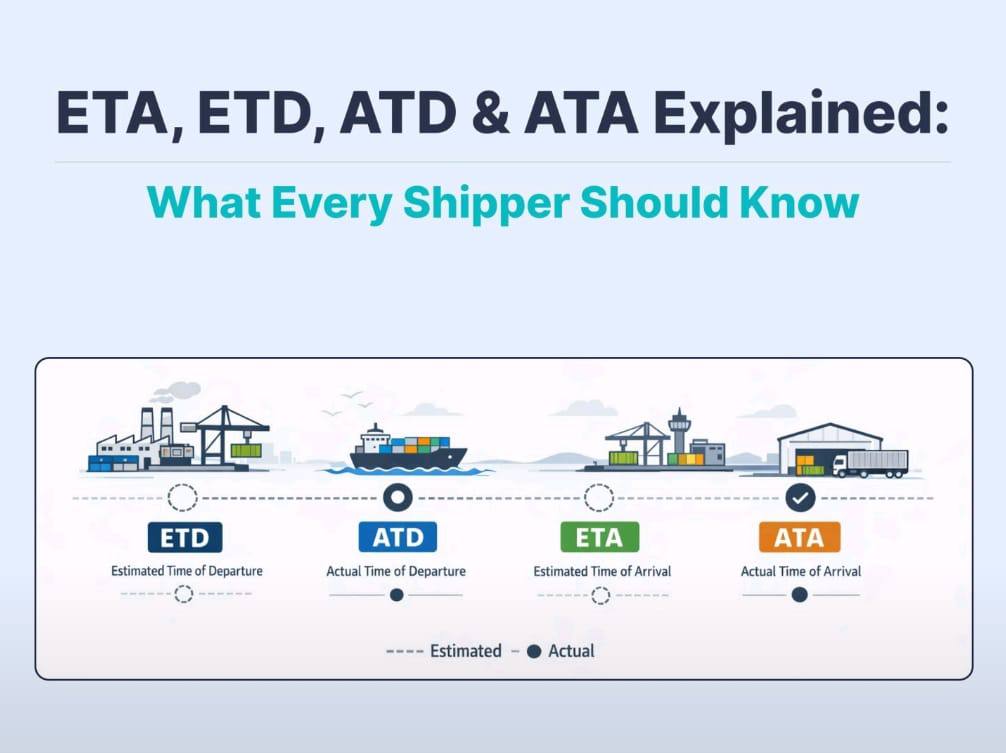
ETA – Estimated Time of Arrival.
ETC – Estimated Time of Completion.
ETD – Estimated Time of Departure.
ETR – Estimated Time of Readiness.
ETS – Estimated Time of Sailing.
EXW – ex. Works - Sales term denoting that the seller is responsible for making the goods available at his works or factory.
Excepted Period – Period during which any time used to load or discharge does not count for the purpose of calculating demurrage or despatch, other than by prior agreement.
Exceptions Clause – Clause in a Charter-Party or Bill of Lading that exonerates the carrying ship from responsibility for damage to cargo from certain named causes such as an act of God or negligence of the master.
Expiry of Laytime – Moment when the time allowed in the Charter-Party for loading and / or discharging, as the case may be, has been used up.
Extension of a Charter – Prolonging of the period during which a ship is on time charter.
Extension to the Canceling Date – Agreement by the charterer to a later date than that agreed in the Charter-Party by which a ship must tender notice of readiness to the charterer that she has arrived and is ready to load.
Extension to Suit Time – An extension by the carrier of the period within which cargo interests must bring a lawsuit for any claim which they may have under the contract of carriage.
Extra-length Surcharge – Extra charge set by liner conferences on behalf of their members or applied by shipping lines on cargo exceeding a length specified in their tariff often 40 feet or 12 meters.
F
FAC – Fast as Can - Term used in a contract of carriage, particularly in those of shipping lines, to denote that the shipper must supply the cargo as fast as the ship can load or that the receiver must take delivery as fast as the ship can discharge.
FACCOP – Fast as Can Custom of the Port - see FAC - Fast as Can and COP - Custom of the Port.
FAF – Fuel Adjustment Factor - see bunker surcharge.
FAK – Freight All Kinds - Single freight rate which is charged irrespective of the commodity.
FAS – Free Alongside - Under this term the seller's obligations are fulfilled when the goods have been placed alongside the ship on the quay or in lighters.
F/C – Full and Complete Cargo - This expression characterizes a full cargo, in accordance with the custom of the port, which will either bring the vessel down to her maximum permissible draft or fill the vessel cubically as the case may be.
FCC – First Class Charterers - a commonly used, meaningless phrase, which should be avoided.
FCL – Full Container Load - Quantity of cargo, which fills a shipping container to capacity, either by weight or cubic measurement.
FCL Allowance – Deduction from the FCL freight provided by a shipping line or liner conference to a shipper who loads a minimum number of tons or cubic meters of cargo into a shipping container.
FCL/FCL – Term used to describe a container freight rate whereby the shipper is responsible for packing of the container and the shipper or receiver, as the case may be, is responsible for the unpacking.
FCL/ LCL – Term used to describe a freight rate whereby the shipper is responsible for packing of the container and the shipper or receiver, as the case may be, is responsible for the unpacking.
FD – Free Despatch - Provision in a voyage Charter-Party that despatch money is not payable when loading and/or discharging has been completed in less than the time allowed.
Ferticon – Voyage Charter-Party used for shipments of fertilizer, published by the Chamber of Shipping.
Fertivoy – Voyage Charter-Party used for shipments of fertilizer from the United States of America and Canada.
FEU – Forty Foot Equivalent Unit - Unit of measurement equivalent to one 40-foot container.
FHEX – Fridays and Holidays Excepted - Charter-Party term, which provides that Fridays and holidays do not count in the calculation of laytime.
FI – Free In - Free of expense to the shipowner of cargo handling at the loading port.
FILO /FILTD – Free in Liner Out / Free in Liner Terms Discharge - Qualification to a freight rate denoting that it is inclusive of the sea carriage and the cost of discharging.
FIO – Free In and Out - Term qualifying a freight rate which signifies that it excludes the cost of loading and discharging and if appropriate to the type of cargo, stowing, dunnaging, lashing and securing or trimming, all of which are paid by the charterer or shipper or receiver, as the case may be.
FIO LSD – Free In and Out, Lashed, Secured and Dunnaged - Qualification to a freight rate, which is equivalent to free in and out, but which avoids any ambiguity by specifying that the cost of lashing, securing and dunnaging is not for the account of the shipowner.
FIOS – Free In and Out and Stowed - Qualification to a freight rate which is equivalent to free in and out but which avoids any ambiguity by specifying that the cost of stowage is not for the account of the shipowner.
FIOT – Free In and Out and Trimmed - Qualification to a freight rate which is equivalent to free in and out but which avoids any ambiguity by specifying that the cost of trimming is not for the account of the shipowner.
Firm Offer – An offer that is not conditional in any way and is binding on the party making it, provided that it is accepted in full and within any time limit specified in it.
First Class Ship – Ship to which the highest class has been given by a classification society in accordance with its rules concerning construction and maintenance.
Fix (to) – To conclude successfully negotiations resulting in the charter of a ship or cargo.
Fix Best Possible – Situation where the broker is given leeway to negotiate the Charter-Party if terms of original instructions cannot be met in the market.
Fixed on Subjects – Said of a ship, when the terms and conditions of chartering her have been agreed except for a few, normally minor, details.
Fixed Operating Expense – The daily or monthly out-of-pocket costs of operating a vessel, which may include amortization and interest, but does not include fuel or any other variable costs.
Fixture – Successful conclusion of the negotiations between shipowner and charterer, generally through shipbrokers, resulting in the charter of a ship.
FLT – Full Liner Terms - Qualification to a freight rate, which signifies that it consists of the ocean carriage and the cost of cargo handling at the loading and discharging ports, according to the custom of those ports.
FO – Free Out - Qualification to a freight rate denoting that the cost of discharging of the cargo from the ship's hold is not included in the freight but is payable by the charterer or shipper or Bill of Lading holder, as the case may be.
FOB – Free on Board - Sales term denoting that the seller is responsible for delivering the goods to the port of loading agreed in the contract and for loading them on to the ship nominated by the buyer.
FOB Charges – Are cargo handling charges levied on the shipper by the shipping line at the port of loading.
Force Majeure – Circumstance which is beyond the control of one of the parties to a contract and which may, according to the terms and conditions, relieve that party of liability for failing to execute the contract.
Forwarding Agent or Forwarder – Person or company who arranges the carriage of goods and the associated formalities on behalf of a shipper.
Foul Bill of Lading – See dirty Bill of Lading.
FOW – First Open Water - Time in Spring or early Summer when rivers, lakes, or seas are unfrozen and sufficiently free of ice to be open to navigation.
Free Time – Period between the time a ship is ready to load or discharge, having given notice of readiness, and the time that laytime commences in accordance with the Charter-Party, during which the charterer or receiver is not obliged to load or discharge.
Freight Broker – Is the broker who is always successful in contracting somewhat above the market level, but who will never risk the loss of business due to the details of a particular Charter-Party clause.
Freight Collect – Freight payable at destination, also referred to as freight forward.
Freight Conference – See conference.
Freight Forward – See freight collect.
Freight forwarder – See forwarding agent.
Freight Payable at Destination – Method of paying the freight often used for shipments of bulk cargoes whose weight is established on discharge from the ship.
Freight Prepaid – Freight which is payable before the contract has been performed.
Freight Quotation – Freight quoted by a shipping line or liner conference, which may be given as an indication only.
Freight Rate – Amount of money paid to a shipowner or shipping line for the carriage of each unit of cargo, such as a ton, a cubic meter or container load.
Freight Tariff – Schedule, published by a liner conference or shipping line, containing freight rates for a variety of commodities likely to he carried by the lines and whether these are payable on the weight of commodity or its cubic measurement.
Freight Ton – Unit of cargo on which a freight rate is based, generally one ton or one cubic meter whichever is greater.
FRT – Freight - Amount of money paid by a shipowner or shipping line for the carriage of cargo.
G
GA – General Average - Intentional act or sacrifice that is carried out during voyage to preserve the venture from a real peril.
Gless – Gearless Ship - Ship which is not equipped with her own crane(s) or derrick(s).
Gencon – Widely used general purpose voyage Charter-Party published by BIMCO.
General Average Clause – Clause in a Bill of Lading or Charter-Party that stipulates in what country or place and by what rules. often the York-Antwerp Rules, general average is to be adjusted.
GRI – General Rate Increase - Periodic increase to all the base freight rates in the tariff of a liner conference or shipping line.
Grain / Grain Capacity – Total cubic capacity of a ship's holds available for the carriage of grain or any other free-flowing bulk cargo which is capable of filling the space between the ship's frames.
Gross Terms – Type of voyage charter in which the shipowner pays for loading and discharging.
Groupage – See consolidation.
Groupage Bill of Lading – Bill of Lading, issued by a carrier to a forwarding agent, sometimes known as a groupage agent or consolidator, which covers consignments from various shippers for the same destination which have been consolidated into one consignment by the forwarding agent.
GT – Gross Tonnage - The total of all the enclosed spaces within a ship expressed in tons each of which is equivalent to one hundred cubic feet.
H
HA – Hatchway - Opening in the deck of a ship though which cargo is loaded into, or discharged from, the hold.
Hague Rules – Rules governing the carriage of goods by sea and identifying the rights and responsibilities of carriers and owners of cargo.
Hague-Visby Rules – Set of rules, amending the Hague Rules, published and subsequently given the force of law by many maritime nations.
Half Hire – Provision in a time Charter-Party that half of daily hire is payable under certain circumstances.
Hamburg Rules – Rules governing the rights and responsibilities of carrier and cargo interests which may be incorporated into a contract for the carriage of goods by sea either by agreement of the parties or statutorily.
Harbor Dues – Charge levied against a shipowner or ship operator by a port authority for the use of a harbor.
Head Charter – Contract for the charter of a ship between her owner and a charterer.
Head Charterer – Charterer whose contract is direct with the shipowner in respect of a ship that is being chartered out and the sub-chartered, perhaps several times.
Hire or Hire Money – Money paid by a charterer to a shipowner for the hire of a ship taken on time charter.
Hire Statement – Written statement of the amount of hire money payable by a time charterer to a shipowner, showing the number of days that have elapsed since the commencement of the charter or since last statement.
Ho. – Hold - Space below the deck of a ship, used for carry cargo.
House Bill of Lading – Bill of Lading issued by a forwarding agent to a shipper covering a consignment, which the forwarding agent has grouped with consignments from other shippers to the same destination.
Husbandry Agent – This is the agent appointed by the shipowners to attend only to those non-cargo matters - specifically those matters concerning vessel crew, repairs. supplies, and provisioning and classification society surveys.
HWONT – High water ordinary neap tides.
HWOST – High water ordinary spring tides.
I
Ice Clause – Clause in a Bill of Lading or Charter-Party that sets out the options available to the panics to the contract of carriage in The event that navigation is prevented or temporarily delayed by severe ice conditions.
Identity of Carrier Clause – Clause in a Bill of Lading which stipulates who the carrier is, that is, the part) responsible for the care of the cargo under the terms of the contract of carriage.
Incoterms – Rules governing the interpretation of terms used in international trade, published by the International Chamber of Commerce.
Indemnity – Compensation offered by one party to another for the consequences of carrying out, or omitting to carry out, a certain act.
Independent Line – Shipping line that operates on a route served by a liner conference but which is not a member of that conference, also referred to as a non-conference line or an outsider.
Inducement – Minimum quantity of cargo or freight required by a shipping line to make it worthwhile to call at a particular port of loading or discharging.
Inherent vice – The terms mean any existing defects, diseases, decay or the inherent nature of the commodity that will cause it to deteriorate with a lapse of time.
IWL – Institute Warranty Limits - Geographical limits within which a ship may navigate without incurring any additional insurance premium.
Intaken Weight – Actual weight of cargo loaded on board a ship.
Interclub Agreement – Agreement between a number of major protection and indemnity clubs on the method of apportioning liability for loss and damage to cargo carried in ships chartered under a New York Produce Exchange Charter-Party.
Interim Voyage – Voyage undertaken by a ship between the times she is chartered for a specific voyage and the time she performs it.
Intermodal Tariff – Tariff or freight rates of a shipping line or line conference covering inland as well as ocean legs.
"Issued" Charter – A form of Charter-Party for the establishment of which it might be said that BIMCO is responsible, is referred to as "issued" by BIMCO.
J
Jettison Clause – Clause in a Bill of Lading or Charter-Party setting out the circumstances under which a master is entitled to jettison goods from a ship.
Joint Survey – Inspection carried out by a surveyor on behalf of two parties, the cost generally being borne by both.
Jurisdiction Clause – Clause in a Bill of Lading or Charter-Party, which stipulates that any dispute between the parties arising from the contract, be resolved in a court of law, as opposed to arbitration.
K
KG (s) – Kilograms(s)
KT – Knot
L
Laydays – Days allowed by the shipowner to the voyage charterer or Bill of Lading holder in which to load and / or discharge the cargo.
Laycan or L/C – Laydays Canceling - Period during which the shipowner must tender notice of readiness to the charterer that the ship has arrived at the pod of loading and is ready to load.
Laytime – Time allowed by the shipowner to the voyage charterer or Bill of Lading holder in which to load and / or discharge the cargo.
Laytime Saved – Charter-Party term used to define one method by which despatch money is calculated, that is, by deducting laytime used from laytime allowed.
Laytime Statement – Portion of a time sheet, which details the amount of laytime used by a voyage charterer.
L/C – Letter of credit.
LCL – Less than Container Load - Consignment of cargo, which is insufficient to fill a shipping container.
Letter of Indemnity – Written statement in which one party undertakes to compensate another for the costs and consequences of carrying out a certain act.
Lien Clause – Clause in a voyage Charter-Party which entitles the shipowner to exercise a lien on the cargo, that is, to retain control of the cargo until any freight, deadfreight or demurrage which is owing is paid.
LIFO – Liner In Free Out - Qualification to freight rate denoting that it is inclusive of the sea carriage and the cost of loading.
Liner Bill of Lading – Bill of Lading containing the terms and conditions of carriage of a shipping line.
Liner Waybill – Document, issued by a shipping line to a shipper, which serves as a receipt for the goods and evidence of the contract of carriage.
Linertime – Deep sea time Charter-Party published by BIMCO, used when ships are chartered for liner operation.
Loading Broker – Company that represents a shipping line at the port of loading.
Loose – Said of a consignment, which consists of single pieces not bundled together.
LONL — Lost or Not Lost - Term which may be used in contracts of carriage in which the freight is prepaid.
LS – Lump sum.
LT – Liner Terms - Qualification to a freight rate which signifies that it consists of the ocean carriage and the cost of cargo handling at the Loading and discharging ports according to the custom of those ports.
Lump Sum Charter – Voyage charter for which the freight is payable as a lump sum rather than per ton or other unit of cargo.
LWONT – Low Water Ordinary Neap Tides.
LWOST – Low Water Ordinary Spring Tides.
M
Manifest – Document containing a full list of ship's cargo, extracted from the bills of lading.
Max – Maximum.
MHWN – Mean High Water Neaps.
MHWS – Mean High Water Springs.
Min – Minimum.
Min/Max – Minimum/Maximum - When qualifying the contractual quantity in a voyage charter, this term signifies that the freight is payable on that precise quantity, no more and no less.
Misdescription – Incorrect information concerning a ship given by the shipowner to a charterer or concerning cargo given by a charterer or shipper to a shipowner or shipping line.
MLWN – Mean low water neaps.
MLWS – Mean low water springs.
MOL – More or Less.
Molchop – More or Less in Charterer's Option - Option allowed to a voyage charterer to load up to a certain quantity, normally expressed as a percentage or a number of tons, over or under a quantity specified in the contract of carriage.
MOLOO – More or Less in Owner's Option - Option allowed to a shipowner to carry up to a certain quantity, normally expressed as a percentage or number of tons, over or under a quantity specified in the voyage charter.
More in dispute if on board to be delivered – Notation appearing on a Bill of Lading when the shipper is In disagreement with the ship as to the number of pieces or package tallied on board.
M/R – Mate's Receipt - Receipt made out by the first officer, stating the quantity and condition of the goods loaded on board the ship.
MS – Motor ship.
MT – Metric ton - 1,000 kilograms.
MV – Motor vessel.
N
NAABSA – Not Always Afloat But Safe Aground - Provision in a Charter-Party that the charterer has the right to order the ship to a port where she may touch the bottom in safety.
Negligence Clause – Clause in a Bill of Lading or Charter-Party which seeks to relieve the shipowner or carrier of liability for losses caused by the negligence of his servants or agents.
New Jason Clause – Protective clause inserted into a Charter-Party or Bill of Lading which provides that the shipowner is entitled to recover in general average even when the loss is caused by negligent navigation.
NOE – Not Otherwise Enumerated - Category in a freight tariff of a shipping line or liner conference which covers commodities not specifically described elsewhere in the tariff.
Nomination – Designation of a specific ship for a particular voyage by a shipowner or shipping line.
Non-Conference Line – See independent line.
Non-Negotiable Bill of Lading – Bill of Lading which is not a signed, original Bill of Lading and which is therefore not capable of being used to transfer title in the goods described in it.
Non-Reversible Laytime – Term used in a voyage Charter-Party to signify that the time allowed to the charterer for loading is to be treated separately from the time allowed for discharging for the purpose of calculating demurrage or despatch.
NOR – Notice of Readiness - Provision in a voyage charter that the shipowner or master must advise the charterer when the ship has arrived and is ready to load or discharge for laytime to start counting.
NOS – Not Otherwise Specified - See not otherwise enumerated.
Notice of Redelivery – Written notice given by the time charterer to the shipowner giving the date when the ship is to be returned to the shipowner at the end of the period of the charter.
Notify Party – Party whose name and address appears in a Bill of Lading who is to be notified by the shipping company or its agent of the arrival of the goods at the discharge port.
NT – Net Tonnage - The total of all enclosed spaces within a ship available for cargo expressed in tons each of which is equivalent to one hundred cubic feet.
O
Ocean Waybill – See liner waybill.
Off Hire – Said of a ship on time charter for which hire money has temporarily ceased to be paid by the charterer, for example because of breakdown of the ship or her equipment.
Off Hire Survey – Inspection carried out at the time a ship is redelivered by a time charterer to a shipowner at the end of the period of the charter.
OO – In Owner's Option - Term in a Charter-Party, which stipulates that the shipowner has a choice in specific circumstances.
Open – Said of a ship that is available as from a specified date at a particular place to steam to another port. if necessary. to load her next cargo. having discharged the last one.
Open Conference – Liner conference that does not require its member lines to vote on the admission of a new member.
Open Rate – Freight rate negotiated by a shipper or freight forwarder with a shipping line or liner conference for shipping in excess of a minimum agreed quantity of cargo on any one ship.
Orders – Set of instructions given by the shipowner or ship operator to the master of a ship concerning the next voyage.
Original Bill of Lading – Bill of Lading which bears the original signature of the master of a ship or his agent.
OSB – One Safe Berth - See safe berth.
OSP – One Safe Port - See safe port.
OS&D – Over, Short and Damage Report - See outturn report.
OT – Overtime.
Outsider – See independent line.
Outturn Report – Written statement by a stevedoring company in which the condition of cargo discharged from a ship is noted along with any discrepancies in the quantity compared with the ship's manifest.
Ourturn Weight – Weight of cargo ascertained when it is discharged from a ship.
Overlap – The period of time during which a charterer retains a vessel beyond the stated period of the time charter.
Overage – Cargo discharged in excess of the quantity on the ship's manifest.
Overtonnaging – Situation where there are too many ships generally or in a particular trade, for the level of available cargoes.
Owners Agents – Ship's agent nominated by, and paid by: the shipowner in accordance with the Charter-Party.
Owners Broker – Shipbroker who acts on behalf of a shipowner in the negotiations leading to the chartering out of the owner's ship.
Owners Market – Strong market in favor of Ship Owner's.
P
Paramount Clause – Clause in a Bill of Lading or Charter-Party which stipulates that the contract of carriage is governed by the Hague Rules or the Hague-Visby Rules or the enactment of these miles in the country having jurisdiction over the contract.
Part Cargo – Goods which do not represent the entire cargo for a particular ship but whose quantity is sufficient to be carried on the charter terms.
Part Charter – The chartering of a ship to carry a quantity of goods, which represents only a part of the cargo.
Performance Claim – Claim made by the time charterer against a shipowner when the ship has been unable to achieve the speed agreed in the Charter-Party or has consumed too much fuel or both.
Performance Clause – Clause in a time Charter-Party which stipulates that, should the ship be unable to achieve the agreed speed or should she consume too much fuel, the charterer is entitled to recover from the shipowner the cost of time lost and extra fuel.
PFT – Per Freight Ton — see freight ton.
PLTC – Port Liner Term Charges - Cargo handling charges levied on the shipper by the shipping line at the port of loading.
Point to Port Rate – Freight rate which includes all costs from inland place of the exporting country to the port of discharge in the importing country.
Pooling – Sharing of cargo or the profit or loss from freight by member lines of a liner conference pooling arrangements do not exist in all conferences.
Port to Point Rate – Freight rate which includes all costs from the port of loading in the exporting country to an inland place in the importing country.
Post Fixture – After the contract for the charter of a ship has been agreed. Said of work carried out by a shipowner, charterer or shipbroker, including payment of hire or freight, calculation of despatch or demurrage and the resolution of any disputes.
Preamble – First few lines of a Charter-Party in which the panics to the contract and the ship are identified.
Private Form – Standard Charter-Party devised and used by a particular company.
Pro Forma Charter-Party – Document containing all the terms and conditions of a contract between a shipowner and a charterer but which is unsigned and therefore is not a contract itself.
Pro Forma Disbursements Account – Statement sent by a ship's agent at a port to the shipowner in advance of the ship's call at the port.
Protecting Agent – Agent appointed by the owners or charterers to protect their interest and to supervise the work carried out by the ship's agent when. under the Charter-Party. the vessel is consigned to another's agent.
Protective Clauses – Clauses in a Charter-Party which provide contingencies for unforeseen situations, such as ice, strikes, general average or collision.
Purposes – Time allowed in a voyage Charter-Party for loading and discharging combined, expressed as a number of days or hours.
R
Rate of Demurrage – Amount payable by a voyage charterer to a shipowner for each day used to load and / or discharge cargo in excess of the time allowed in the Charter-Party.
Rate of Discharging / Loading – Number of tons of cargo discharged /loaded each day from / into a ship.
Rate of Freight – See freight rate.
Received for Shipment Bill of Lading – Bill of Lading evidencing that the goods have been received into the care of the carrier, but not yet loaded on board.
Receiver – Party who receives the cargo at the place of destination in the contract of carriage.
"Recommended" Charter – When there has been no proper groups of charterers with whom to negotiate a particular charter, for instance. "Gencon" Charter it is issued as a "recommended" charter.
Redly – Redelivery - Return of a ship by the time charter to the shipowner at the end of the period of the charter.
Redelivery Certificate – Document signed by or on behalf of the shipowner and the charterer, certifying the time, date and place of redelivery of the ship.
Release a Bill of Lading (to) – To provide the shipper with an original Bill of Lading, often in exchange for the freight.
Reversible Laytime – Term used in a voyage Charter-Party to signify that the time allowed for loading may at the charterers option, be added to the time allowed for discharging for the purpose of calculating demurrage or despatch.
RT – Revenue Ton - Unit of cargo on which a freight rate is based, generally one ton or one cubic meter whichever is greater.
Round Voyage – Voyage involving two legs the second of which brings the ship back to the geographical area where the first leg commenced.
Running Days – Consecutive days of 24 hours including weekends and holidays.
S
Saleform – Memorandum of agreement giving details of the purchase of a ship, devised by the Norwegian Shipbroker's Association.
SB — Safe Berth - Term in a charter party which places the responsibility onto the cargo interests to order the chartered ship to a berth which is physically safe for her while she is there for the purpose of loading or discharging.
SD – Single deck ship.
Sea Waybill – See liner waybill.
Seaworthiness – Fitness of a ship for a particular voyage with a particular cargo.
Service Agreement or Service Contract – Agreement between a shipper and a liner conference in which shipper undertakes to ship some or all, as the case may be, of his cargo on conference line ships for a specific period of time in return for an agreed rate of freight and level of service.
SHEX – Sundays and Holidays Excepted - Charter-Party term which provides that Sundays and public holidays do not count in the calculation of laytime.
SHINC – Sundays and Holidays Included - Charter-Party term, which provides that Sundays and public holidays count in the calculation of laytime, whether or not used for loading or discharging, as the case may be.
Shipbroker – Person having one or several occupations: chartering agent or owner's broker, negotiating: terms for the charter of a ship on behalf of a charterer or shipowner respectively, sale and purchase broker, negotiating on behalf of a buyer or seller of a ship: ship's agent, attending to requirements of a ship, her master and crew when in port on behalf of shipowner, loading broker, whose business is to attract cargoes to ships of his principal.
Shipped Bill of Lading or Shipped on Board Bill of Lading – Bill of Lading issued when goods have been loaded on board ship.
Shipper – Person or company who enters into a contract with a liner conference, shipping line or shipowner for carriage of goods.
Ship's Agent – Person who looks after interests of a ship while she is in port.
Short Form Bill of Lading – Bill of Lading which does not have printed on it the full terms and conditions of contract of carriage but instead contains a reference to carrier's conditions.
Short Shipment – Part of consignment which has not been shipped in a specific ship, normally because there was insufficient space in ship or because goods arrived at port of loading after ship has completed loading or has sailed.
Sim Sub. – Similar Substitute - ship offered by a shipowner to a charterer as a replacement for one originally chartered which is similar in respect of principal characteristics.
Sister Ship – Ship with the same specification as another.
SP – Safe Port - Term in a Charter-Party which places responsibility on to the cargo interests to order the chartered ship to a pod which is physically and politically safe for her to reach, remain and leave, taking into consideration cargo to be loaded or discharged.
S & P – Sale and Purchase Broker - Person who negotiates terms for the sale of a ship on behalf of buyer or seller.
SSHEX – Saturdays, Sundays and Holidays Excepted - Charter-Party term which provides that Saturdays. Sundays and public holidays do not count in the calculation of laytime.
SSHINC – Saturdays, Sundays and Holidays Included - Charter-Party term which provides that Sundays and public holidays count in the calculation of laytime, whether or not used for loading or discharging, as the case may be.
Statement of Facts – Statement, prepared by the ship's agent at loading and discharging ports, which shows the date and times of arrival of ship and the commencement and completion of loading and discharging.
Stem – Availability of a cargo on the date or dates on which a ship is offering to load.
Strike Clause – Clause in a Bill of Lading or Charter-Party that sets out the options available to the parties to the contract of carriage in the event that a strike prevents or interrupts loading or discharging of cargo.
Sub-Charterer – Person or company who charters a ship for a party, who is not the owner but who, in turn, has chartered ship.
Sub-Freight – Freight payable by the sub-charterer, normally to the charterer.
Sub. Details – Subject Details - Term qualifying an offer or counter-offer for the charter of a ship which demotes that only minor details remain to be agreed.
Sub. Free – Subject Free - Term used in an offer made by a shipowner to signify that the acceptance of that offer will only result in a contract if one has not been concluded in the meantime with a third party.
Sub. Open – Subject Open - see subject free.
Sub. Unfixed – Subject Unfixed - See subject free.
Subject Stem – Subject to the availability of the cargo on the dates on which a ship is offering to load.
Sub-Let – The charter of a ship to one party by another party who is not the owner but who, in turn. has charter of ship.
Substitute – Replacement for a ship for a particular voyage.
Substitution – The replacement of a ship with another ship.
SWL – Safe Working Load - Maximum load which can safely be borne by a lifting or hauling appliance, such as crane or winch.
T
TA Round – Transatlantic round voyage.
Tariff – Schedule of charges. such as: freight tariff of a shipping line or conference, in which are published freight rates, generally for a wide variety of commodities.
TBA – To be advised.
TBN – To Be Nominated - Said in respect of a voyage for which a specific ship has yet to be designated by the shipowner or shipping line.
Tender Notice of Readiness (to) – As master of a ship to present cargo interests or their agent with written notice that the ship has arrived and is ready to load or discharge, as the case may be.
TEU – Twenty Foot Equivalent Unit - Unit of measurement equivalent to one 20 foot shipping container.
Through Bill of Lading – Bill of Lading issued by a shipping line for a voyage requiring on-carriage, thus involving at least one transshipment.
Time – Frequently used term to mean laytime.
Time Charter – The hiring of a ship from a shipowner for a period of time. Under this type of contract, the shipowner places his ship, with crew and equipment, at the disposal of the charterer, for which the charterer pays hire money.
Time Charterer – A person or company who hires a ship for a period of time.
Time Charter-Party – A document containing terms and conditions of a contract between a charterer and a shipowner for the hire of a ship for a period of time.
Time Lost Waiting for Berth to Count – A Charter-Party expression which denotes that laytime are to start from the time of Notice of readiness is presented by master to charterer's agent, ever, though vessel is held up because no berth is available.
Time reversible – Overall calculations of laydays, in loading and discharging in a voyage Charter-Party.
Time Sheet – Statement, drawn up by the ship's agent at loading and discharging ports, which details the time worked in loading or discharging the cargo together with the amount of laytime used.
Time to Begin on Arrival – A Charter-Party clause referring to the laytime in the strict sense that time is to count immediately on rival at the port of loading or discharging irrespective whether a berth is available or not.
Ton Mile – Unit cargo ton/distance carried and covered.
TPC – Tons per Centimeter - A quantity, for example of cargo or fuel, needed to immerse a ship one further centimeter.
TPD – Tons per Day - The quantity of cargo loaded or discharged each day.
TPI – Tons per Inch - A quantity, for example of cargo or fuel, needed to immerse a ship one further inch.
Turn Round Time or Turnround or Turnaround Time – Time between a ship arriving in port and sailing.
Turn Time – Time during which a ship waits for a berth.
U
UBC – Universal bulk carrier.
UCE – Unforeseen circumstances excepted including MEBD (Main engine breakdown).
Unclean Bill of Lading – See dirty Bill of Lading.
UU – Unless Used - Charter-Party term which provides that a proportion normally all or half, of time used to load or discharge, as the case may be, during excepted periods counts for purpose of calculating total time used.
V
V/C – Voyage Charter - Contract of carriage in which charterer pays for the use of a ship's cargo space for one, or sometimes more than one, voyage.
Voyage Charter-Party – Document containing terms and conditions of a contract between a charter and a shipowner for the use of a ship's cargo space for one, or more than one voyage.
Voyage Estimate – Calculation of the profitability of a prospective voyage of a ship using estimated figures.
W
War Clause – Clause in a Bill of Lading or Charter-Party which sets out the course of action open to the master of a ship in the event that the ship or her cargo or crew would be put at risk because of war should the voyage proceed.
Waybill – See Liner Bill.
WEF – with effect from - This is said, for example, of the date when a new or amended surcharge of a shipping line takes effect.
WIBON – Whether in Berth or Not - Provision in a voyage charter that, once the ship has arrived at the port and tendered notice of readiness, if required, laytime will start to count in accordance with the Charter-Party whether or not the ship has reached the berth.
WIPON – Whether in port or not
WIFPON – Whether in free Pratique or not
Withdraw a ship from the service of the charterer (to) – To remove control of a ship from the time charterer for the remaining period of the charter.
WOG – Without Guarantees.
Workable Hatch – Term in a voyage charter which determines the number of days allowed for loading and / or discharging 'by dividing the quantity of cargo in the largest hatch by the quantity per workable hatch per day as stipulated in the Charter-Party.
Workable Crane – Term in a voyage charger which determines the number of days allowed for loading and / or discharging by the number of cranes available for use by the charterers for operations.
Working Day – When normal working is carried out in a port.
Working Day of 24 Consecutive Hours – Working day equates to one layday.
Working Day of 24 Hours – Period of time which contains 24 normal working hours.
WP – Weather Permitting - Term used in a voyage charter to signify that laytime does not count when weather conditions do not allow loading or discharging operations to be carried out.
WTS – Working Time Saved - Charter-Party term used to define one method by which despatch money is calculated, that is, by deducting laytime used from laytime allowed.
WWD – Weather Working Day - Days on which work is normally carried out at a pod arid which counts as laytime unless loading or discharging would have ceased because of bad weather.
WWR – When Where Ready - Frequently used provision in a time charter to determine the time and place of delivery / redelivery of a ship by the charterer to the shipowner. This term is qualified in such a way as to make the time and place unambiguous. such as on completion of discharge at a named port, abbreviated to w.w. r.c.d. followed by the name of the port.
WWRCD – When Where Ready on Completion of Discharge - see WWR - when where ready above.